Whenever I hear about some new protest by the Russian opposition, I always remember an old joke:
“The chickens are dying! Help!” the chicken coop owner cries out to the village elder.
‘Hang a paper circle over the coop!’ the elder advised.
“It didn’t help; they’re dying again!”
“Then hang a square of paper!”
“They’re all dead!”
“What a pity,” the elder sighed, “I still had so many ideas!”
Four years have passed since Russia began its full-scale war against Ukraine, yet the Russian opposition continues to hang “pieces of paper over the chicken coop” with their half-measures instead of taking real action. While Russian missiles and drones destroy Ukrainian cities, Russian opposition leaders in exile mimic protest activities in Berlin, Prague, and Vilnius.
Slacktivism as a profession
A defining feature of “Russian opposition” rallies is their aestheticization. Armed with catchy slogans, ribbons, and white-blue-white flags, as well as a belief in the “beautiful Russia of the future,” opposition activists attempt to overthrow Putin’s dictatorship with declarations and window dressing.
However, dictatorships don’t disappear because of flashy performances. Is that even the goal of the so-called Russian opposition, though? Years of war have shown that many of these events are aimed more at shaping a positive image of Russians abroad for the purpose of successful fundraising rather than at transforming the Russian Federation. The logic is: “We do not support the war, so we are not responsible for it and do not need to make efforts to stop it.”
Meanwhile, the Western media eagerly pick up on these spectacles, trying to see a “different Russia” in the faces of these émigrés. However, for those who understand the nature of Putin’s regime well, the idea of fighting the dictatorship with marches and ribbons is bitterly ironic. It’s akin to a flock of sheep trying to stop a rabid predator with resolute bleating.
Despite the loud rhetoric about a “historic moment” that accompanied all of the Russian opposition’s media campaigns, none of them led to changes in the structure of power or policy. In fact, this type of opposition is even beneficial to the Russian regime because it creates the illusion of protest without posing a threat to the system.
In political science, there is a term for this phenomenon: “slacktivism.” It refers to “armchair” or purely symbolic protests that involve no risk or action, and create a sense of participation, yet have almost no impact on real change.
This article will examine a striking example of slacktivism in the history of the Russian liberal movement.
On ribbons and queues
The “Green Ribbon” campaign emerged in the spring of 2022 as an anonymous protest against Russia’s full-scale invasion of Ukraine. Russian opposition groups encouraged individuals to purchase green ribbons and attach them to tree branches, benches, handrails, and poles. Instead of engaging in genuine resistance, which requires weapons, funding, or at least sabotage, Russian society opted for color therapy. Municipal services cut down the ribbons faster than they could be photographed and shared on opposition Telegram channels.
Another telling symbolic act by the Russian opposition was the so-called “flashlight protests,” which took place on the eve of the full-scale invasion of Ukraine. Alexei Navalny’s team came up with the idea for the campaign, which does little more than elicit a smile. Participants were instructed to go out into their courtyards in the evening, turn on the flashlights on their phones, hold them up, and take photos or videos to post on social media.
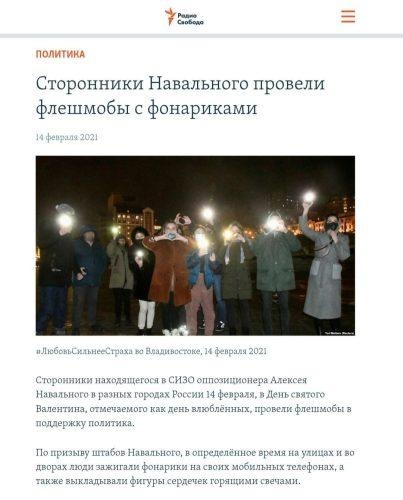
In an attempt to give the event a romantic touch, it was tied to Valentine’s Day. Some Western media outlets covered it as a creative form of nonviolent resistance to authoritarianism. However, the actual political impact was negligible.
The only response came from Dmitry Peskov, Putin’s press secretary, who responded ironically. “Yes, some people were walking around with flashlights,” he said. “Great!”
The “flashlight protests” were one of the first examples of the Russian opposition shifting from direct confrontation to media spectacles. This campaign set the format for many subsequent actions, because it posed a minimal risk to participants but had high visual impact.
Following Alexei Navalny’s death, his wife Yulia attempted to assume a leadership role in the Russian opposition. However, rather than intensifying their actions in response to the murder of their leader, the opposition started imitating a fight against the regime.
The effectiveness of the “Noon Against Putin” flash mob in March 2024, for example, still raises many questions and has drawn considerable criticism.
The campaign encouraged everyone who opposed the regime to go to the polling stations at 12:00 p.m. on March 17. Participants were asked to stand in line, spoil their ballots, or vote for anyone but Putin. Yulia Navalnaya explained that the Russian Criminal Code does not penalize being at a polling station at a specific time, making it a safe way to make a statement.
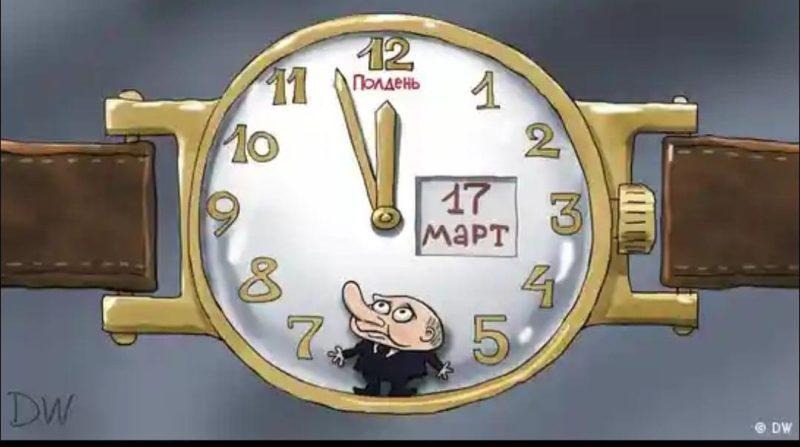
However, the Kremlin used these lines as proof of high voter turnout among Russians. Propagandists happily filmed the crowds and reported in the news about the “unprecedented consolidation of society around Putin.” The Russian president’s speech was the final note, in which he thanked the opposition for adding legitimacy to the people’s will through their protest.
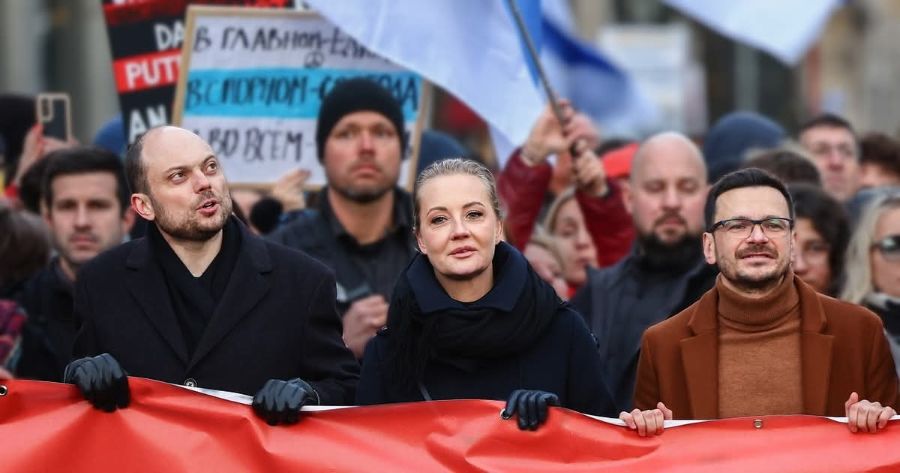
The first “Berlin March” in November 2024, a joint initiative by Yulia Navalnaya, Ilya Yashin, and Vladimir Kara-Murza, drew thousands of émigrés. The event primarily served as a visual signal to Western institutions and media to demonstrate that there is “another Russia.” At the same time, this walking performance did not cause even the slightest discomfort for the Kremlin.
The “I’m Online” campaign, also known as “Я на связи,” is Yulia Navalnaya’s initiative for a free internet in Russia this year. As part of the campaign, users are encouraged to download Instagram Stories stickers with anti-censorship slogans.
However, the actual impact of digital activism is highly questionable from a behavioral psychology perspective. According to research by K. M. Christofferson, S. E. White, and J. Pelosa, symbolic acts of support online actually reduce the percentage of people who subsequently donate money or time to real-world causes. This occurs because virtual participation creates a sense of having fulfilled one’s duty, thereby lowering motivation for further action.
Another joint campaign by the Russian opposition titled “Lines of Hope” (“Очереди надежды”), was a notable episode in a series of symbolic campaigns. This initiative aimed to collect signatures in support of nominating Boris Nadezhdin as a candidate in the Russian presidential election in the winter of 2024. As a reminder, people also “stood in line” during the “Noon Against Putin” campaign. Thus, “standing in line” has become the most popular form of resistance.
However, the campaign itself contained a fundamental contradiction. Boris Nadezhdin presented himself as an “anti-war candidate,” even though his stance on Russian aggression was ambiguous. While Nadezhdin did criticize the full-scale invasion and mobilization, he did not propose reevaluating Russia’s imperial policy. Specifically, he did not support returning occupied territories to Ukraine and other countries (i.e Abkhazia and South Ossetia in Georgia).
Thus, the “Lines of Hope” do not represent a stance against war as an imperial project. Rather, they express a desire for a “neat” occupation, like the one that occurred in 2014. They represent a longing for the days when “little green men” — a term used to describe heavily armed, masked Russian soldiers wearing unmarked green military uniforms who appeared in Ukraine during the annexation of Crimea in early 2014 — seized Crimea without sanctions or mobilization.
Another striking example of naive resistance is Ilya Yashin’s “Enough!” campaign. Its essence boils down to a call: “Enough fighting. Enough killing.”
This case illustrates why Ukrainians and levelheaded global analysts view the Russian opposition with undisguised irony. First, who is this “Enough!” directed at? Is it directed at Putin, who has sacrificed a million lives for the sake of imperial ambitions? Or is it directed at the Russian OMON (heavily militarized riot police), who receive bonuses for beating protesters? Or is it the same desperate bleating of sheep trying to appease the predator with the word “enough”?
The slogan “Enough!” contains no call to action. It doesn’t say “donate to the Armed Forces of Ukraine to end the war,” “Burn down the military recruitment offices so that neither Russians nor Ukrainians die in the war,” or “Sabotage the railways.” It’s just a verbal marker that lets a Russian liberal hit “like” and go have a latte.
As part of this campaign, Yashin and his allies are once again trying to push the narrative that “Russians are also victims of Putin.” The idea is that everyone is suffering and tired, and we should just say “enough.” However, this blurs the line between aggressor and victim by equating the suffering of Ukrainians under bombardment with the discomfort Russians experience from sanctions or the fear of mobilization.
Garry Kasparov stands out against the general backdrop of the Russian opposition as the only figure whose activities appear more substantive. For instance, the German newspaper Bild has published his articles advocating for greater military assistance to Ukraine, including the provision of long-range weapons. His main project is the “Free Russia Forum” in Vilnius. This platform discusses the future of the Russian Federation after Putin, the country’s decentralization, and the rejection of the imperial model.
The most effective Russian opposition today, however, is the “Russian Volunteer Corps” (RVC), which is fighting for Russia’s freedom in the Ukrainian army. They have long since shed their illusions and understand the obvious truth: only armed hunters can stop a predator.
Go into battle, not to the slaughter
Whenever the toothlessness of the Russian resistance is brought up, the liberal community immediately puts up a defense: “It’s easy for you to criticize! In Russia, they throw people in jail for saying the wrong thing. What kind of actions do you expect from us in a totalitarian system? Do you want us to be killed like Navalny?”
Alexei Navalny’s return to Russia in January 2021 was indeed, the most dramatic act of Russian resistance. It is, undoubtedly, a powerful moral act. However, when viewed through the lens of political strategy, Navalny’s feat had no real impact on the protest movement. It merely dealt a fatal blow to the Russian opposition.
Why wasn’t this move an example of political struggle? Because a struggle involves conserving resources. Voluntarily surrendering to one’s tormentor, however, is martyrdom, not politics. Perhaps Navalny had hoped that his arrest would rally millions, but he fatally misjudged his own society. By sacrificing himself, he left the massive Anti-Corruption Foundation without a strong leader at the most critical moment in its history.
Unfortunately, he became a victim of his own strategy. For years, Navalny and his team had brought people out into the streets under the slogans “We are unarmed!” and “This is our peaceful protest!” When OMON brutally beat students, the headquarters’ coordinators urged people to “document violations for the European Convention on Human Rights” and to never resist the police. This methodically neutered the Russian protest, conditioning people to believe that the main objective was to be a victim—beaten up and captured on camera.
Consequently, the leader’s death signaled not for an uprising, but for an end to any action.
If even a leader with millions of supporters and global backing could die helplessly in prison, then an ordinary Russian certainly had no reason to take any risks.
This learned helplessness gave rise to all the subsequent “masterpieces” of opposition activity: from standing in lines for the Kremlin-approved Nadezhdin, to calls to change profile pictures on social media.
The Masters of the “No” Movement Against Putin
Anti-war actions are being carried out by not only Russian opposition politicians, but also by opposition media outlets. Since Russia’s full-scale invasion of Ukraine began, some of these media outlets have positioned themselves as participants in the anti-war movement. A notable example of this activity was the “NO” exhibition organized by the Meduza media outlet in Berlin.
The project was formally positioned as a gesture of protest against war, violence, and authoritarianism. However, the concept of the exhibition elicited a mixed reaction, particularly due to its political ambiguity and cautious wording.
At the heart of the project is the abstract slogan, “No to War!”, as coined by Yashin. This slogan was realized through artistic images, installations, and photographs. In other words, rather than political directness, we saw the aestheticization of protest—a tactic already familiar to us from politicians’ campaigns.
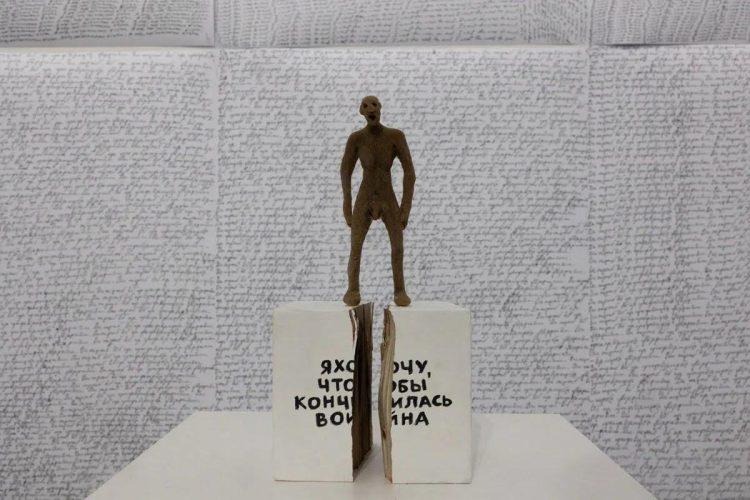
The exhibition framed the war as a “universal human tragedy,” blurring the clear distinction between aggressor and victim. The Russian invasion was presented not as a deliberate imperial crime by the Russian Federation, but as a “shared catastrophe” that supposedly traumatized everyone equally.
The NO exhibition extended the concept of the “safe protest” invented by opposition politicians, which does not involve any real confrontation with the Russian regime. At the same time, it projected an image of an “alternative Russia”—one that is cultural, humanistic, and anti-war—to Western audiences.
“This is classic escapism”
To gain a detailed understanding of the phenomenon of the media and political “activities” of Russian political émigrés, we turned to Viktoria Kovpak, a professor in the Department of Social Communications and Information Activities at the Faculty of Journalism of Zaporizhzhia National University and Ph.D. in Social Communications (Ukraine). She studies issues of decolonization, the transformation of the media landscape, and countering propaganda narratives.
The researcher argues that “the phenomenon of the so-called Russian liberal opposition and the émigré intelligentsia should be viewed through the lens of a sociocommunicative simulacrum and the ritualization of protest. Instead of real political agency and a pragmatic struggle against the regime, we observe a complete replacement of real action with communicative performance. A striking example of this is the anti-war march in Berlin organized by Y. Navalnaya, I. Yashin, and V. Kara-Murza. An analysis of its semantic architecture reveals a total lack of operational goals. Slogans such as ‘Putin is not Russia’ or ‘Russia will be free’ represent purely abstract pacifism that offers no mechanism for deconstructing the totalitarian system. As Ukraine’s ambassador to Germany, Oleksiy Makeyev, quite accurately noted, such marches turn into banal PR stunts aimed not at the Russian population, but at the German media and politicians. This is a struggle for the attention of European elites, not a struggle against the Kremlin. The fact that even opposition-loyal speakers, such as filmmaker V. Mansky, acknowledge the march’s purely “symbolic significance” and its inability to influence the withdrawal of troops, underscores these political emigrants’ complete capitulation to reality. Take Yulia Navalnaya, for example. She reduces political resistance to everyday theatricality. Her statement that she is ready to ‘climb onto a table and say that Putin is a murderer’ is similar to her assertion that ‘Crimea is de facto Russian.’ Previous years of similar activities under the slogan ‘to show that many Russians are against it’ have proven that ritual gestures in safe European capitals do not translate into real opposition to aggression. Furthermore, the emphasis that the march leaders place on the Russian tricolor flag, as well as their calls to lift sanctions against ‘ordinary citizens’ suggests the preservation of an imperial mindset and the desire to protect their own comfort. In communication theory, this is a classic case of symbolic escapism,” stresses the expert.
The professor also draws attention to a notable figure in recent Russian anti-war journalism: interviewer Ekaterina Gordeeva. This journalist has gained widespread international fame thanks to her emotional coverage of the human tragedies of the war, including the plight of refugees and civilian casualties. To many Western viewers, Gordeeva has become a symbol of Russia’s “anti-war voice.”
Her false humanism — most evident in her interview with Peter Ruzavin — and her childish condemnation of armed resistance are intended solely to shield the émigré bubble from guilt [Peter Ruzavin, a Russian journalist, voluntarily joined the Armed Forces of Ukraine because he believes that fighting Putin’s regime is the only way to liberate his homeland. During the interview, Gordeeva questioned the morality of his decision to participate in the war, attempting to appeal to his sense of guilt. However, Ruzavin himself emphasized that armed resistance is the appropriate response to Russian aggression and the regime’s crimes]. The white ribbons, lining up in queues (as during the ‘Noon Against Putin’ campaign), Gordeeva’s philosophy of stopping hatred and the thirst for revenge serve the exclusively therapeutic function of self-justification. It is an attempt to legitimize the status of a ‘good Russian’ in the eyes of the world without accepting real risks or collective responsibility,” states Viktoria Kovpak.
The scholar argues that historical experience shows aggressive authoritarian regimes rarely stop because of concessions made by their victims. Concessions are often perceived as a sign of weakness, encouraging further expansion. This is precisely why a significant portion of Ukrainian society does not view calls for a unilateral cessation of resistance as a path to peace. Instead, they see it as a path to capitulation that does not address the causes of the war or guarantee future security.
“As long as this discourse denies the need for the decolonization of the Russian Federation itself and the genocide status of Russia’s war against Ukraine, it remains not an instrument of change but an element of system stabilization through the safe channeling of protest sentiments,” emphasizes Ms. Kovpak.
Freedom must be fought for
This kind of spineless, ritualistic, expatriate opposition suits Putin perfectly. It is not a glitch in the system, but rather an instrument of it. The Kremlin has long understood that totalitarian calm is sustained by both fear and the illusion of choice. Through these performances, a dissatisfied Russian can safely let off steam. Instead of going to the military registration office to burn the rosters, blocking the railroad, or forming an underground resistance, liberal Russians post a profile picture with a dove and feel like fighters.
Is it dangerous to challenge Putin’s regime? Absolutely! In his essay “Small Change,” writer Malcolm Gladwell noted that true historical change does not arise from “weak ties,” such as social media likes, but from “strong ties” involving real action and real risk. That is precisely why Ukrainians today risk their lives on the front lines daily and live under shelling in the rear, fighting for the right to live freely.
Throughout history, mass civil protests have proven to be an effective tool for political change. For instance, demonstrations during the 2003 Rose Revolution in Georgia led to the resignation of President Eduard Shevardnadze. In Ukraine, the Orange Revolution forced a rerun of the presidential election, and the Revolution of Dignity resulted in a change of government. Protest movements also played a pivotal role in the collapse of the communist regime in Czechoslovakia in 1989 and the overthrow of Ferdinand Marcos’s regime in the Philippines in 1986. These examples demonstrate that protest can become an effective mechanism for influencing those in power when there is the political will.
In contrast, Russia’s so-called elite have chosen the path of safe conformism. Behind their passive facade lie the same secret desires for their own “greatness.”
“Russians need to understand that as long as they indulge in imperialist fantasies, they’re in for a rough ride. They need to make the connection between imperialism and total disaster,” British writer Peter Pomerantsev says bluntly.
However, together, we must make this cause-and-effect relationship clear to them.
Iryna Avramenko